 504. FlashbackFORMULA: The Undiscovered Country + Violations + Dark Page + Trials and Tribble-a-tionsWHY WE LIKE IT: Star Trek VI.WHY WE DON'T: Everything aboard Voyager.REVIEW: It's Star Trek's 25th Anniversary, and while DS9 went off exploring the TOS era, Voyager opted for the Movie era. Given that Sulu (and Janice) weren't featured in Trials, but were conveniently on the Excelsior together in ST VI, it seems a perfect opportunity to include them. Sulu's Excelsior was one of my favorite things about The Undiscovered Country, and seeing a few more details about their adventure while Kirk and McCoy rotted in prison, is a highlight of this episode. And unlike Trials' CGI manipulations, Flashback can use the actors and create whole new scenes. Great!The conceit here is that we're really in Tuvok's head, witnessing his memories of being an ensign on Excelsior (so any discrepancies can be attributed to faulty memory). Tim Russ wasn't actually in ST VI, but his station is out of the way enough that he might have been, and there are enough recognizable bit parts from the movie to make this feel really part of the movie. Tuvok is not only mentored by Rand (some have been mean and mentioned how much weight she's gained, but I can't be bothered to notice that when her acting is so atrocious), but made the tea Sulu drinks at the start of the film. He's also Valtane's roommate (that's the guy who gives the Praxis info-dump).The untold adventure of the Excelsior includes the appearance of Kang, always played with gravitas by Michael Ansara. There's a little skirmish in a nebula, some nice effects (including movie-style torpedoes) and that's pretty much it, but it's fun. Other good bits include Sulu's hero shot coming out of the steam, the (I think) new idea that Rand was First Officer, and Sulu's speech about loyalty, duty and family. Very TOS. Very good.Not so good is the premise and how it plays out. A virus hiding in a memory (or as a memory) is a Brannon Braga idea to be sure. Not too bad, but it requires a lot of set-up, and because we're exploring a memory, the action tends to repeat a couple times. And when it all goes wrong, it seems that it's just to force Janeway to steal Rand's clothes and dress up in a baggy old uniform (what, Tuvok can't remember a single locker?). It's a highly ridiculous sequence to get some interaction between Janeway and the older characters.And there's a lot of padding besides. Neelix talking about cuisine in his culture is interesting, but has only the slimmest thematic link to the rest of the episode (telling the story of your ingredients). There's an over-long scene where Tuvok builds a puzzle, a lot of starring at screens and nebulae, two mindmelds, and Janeway acting like a cabbage head who doesn't know her own best friend's personal history. And Janeway musing that the TOS gang would have been booted out of Starfleet "today" is borderline insulting and has no place in such a homage. It certainly lacks the humor of "the man was a menace" from Trials.LESSON: That an Excelsior series would have been very cool indeed. (You think Christian Slader would have accepted TV work?)REWATCHABILITY - Medium-High: Sulu easily carries the Excelsior scenes and it's great to return to that era, but Flashback could have used a tighter script. As it is, it only made Voyager look bad in comparison to the Movie era.
 Sometimes you have little to say, but lots to think about...
Crazy action or realism? I can't seem to make up my mind.
Playing with rookies: Can you teach a new dog old tricks?Why do Time Travel RPGs have to be so complicated?
Is there any particular reason why Sword & Sorcery is so boring to my group (me included)?
If you play a jackass, how does the rest of the group know you're not one yourself?
Someone in my group tried playing with another gang. 9 hours straight. 11 players at the table. My own games have 5 players tops and last about 3-4 hours. Which game is the aberration?
And finally: Why aren't I posting about Doctor Who instead?
 503. Basics, Part IIFORMULA: Arena + (Rascals - kids)WHY WE LIKE IT: The characters being smart.WHY WE DON'T: Seska's death.REVIEW: In what amounts to my new favorite Voyager story (there's not a lot of competition, I admit), the second part of Basics allows the characters to shine without all their usual kit. The grisly matter of survival is well-handled with uniform dew collectors, locks of hair to help start fires and Janeway eating grubs. The location work remains stellar and the lava floes are realistic. If the land wasn't inhospitable enough, they also have to contend with a CGI monster and an indigenous tribe, AND have poor baby Naomi on their hands, sick and frail.Mr. Hogan, probably doomed since the first time he got a line, gets mauled and eaten by the the CGI monster (which is ok, though of course, you can tell). Too bad, though there's some nice horror-movie camera work in that scene. The primitives are competent creations, and give Chakotay a chance to show off some psychology and anthropology (in addition to his outdoorsman skills). Eventually (inevitably?), a shared danger and selfless rescue affords the crew the chance to bond with the tribe, but it doesn't seem too forced, and the effects support the action.Back on the ship, Suder and the Doctor make a nice pair of saboteurs. The Doctor gets a nice turn faking out Seska, but it's Suder who remains the most interesting, as a killer unwilling to kill. Though he is sadly killed at the end of the episode, his real sacrifice was that of his soul, and his anguish is palpable. Paris gets his licks in as well, returning with the Talaxian fleet and a good plan. Each character gets to be smart and NEEDS to be smart to get Voyager back. It's the best kind of story where characters are equal to the task, and the task equal to the characters.As for the villains of the piece, this is the Kazons' last real appearance, and though I won't be sorry to see Culluh go (he never amounted to anything), Seska is another matter. I don't think Voyager ever had a better villain. Her death is strange indeed, since everyone else was zapped just as she was and survived, including her baby. She just... dies. That's cutting off the Kazon arc a little too cleanly, I'd say. Indeed, with the revelation that Chakotay's baby is actually Culluh's (silly Seska, you can't impregnate yourself with spinal fluid!), there's no reason to stick around Kazon space a minute longer.LESSON: When Michael Piller reminds you about something, you REMEMBER IT, DAMMIT!REWATCHABILITY - High: Who should have lived or died may be arguable, but the fact remains that this story is filled with tension, excitement, and smart characters doing smart things. The one to beat.
 Thanks xkdc, I really needed this.If you don't get it, count yourself lucky.
 502. Basics, Part IFORMULA: Maneuvers + Meld + (Rascals - kids)WHY WE LIKE IT: Suder's back. Seska's back.WHY WE DON'T: Culluh's back. (Seriously? The Doctor's trip outside.)REVIEW: The Kazon finally make some progress, running Voyager through the kind of gauntlet this part of space should always have been. Dangerous and nasty. Of course it helps that Seska is with them and running things from behind the scenes. (Indeed, Culluh is never more than just an impatient bully and far less interesting.) She's got Chakotay running after his baby, and the Kazon ships hitting non-vital systems, mystifying the crew. She's sent a pretty convincing Trojan horse to blow himself up at an opportune time. By the time the auto-destruct has failed because it was a non-vital system, you know Voyager has well and truly lost to a smarter opponent.Leaving them all on a harsh, volcanically active planet, Culluh makes a good point. Can they survive without their toys? Voyager has been entirely too much about bling and bling words. It's a nice location too, what we see of it here, though not quite as harsh as it seems flying in. They're not all left behind of course. The episode makes sure to save a few "rebels" to resolve the situation in Part II (thankfully, it's not set up as a deus ex machina in the making). Tom Paris is off to get help, the Doctor deactivates himself for the time being, and then there's... Suder.Yes, Brad Dourif is back, continuing his story on from Meld. Still an interesting character, here he hopes to help the ship somehow (as a gardener), though he must still keep his temper in check. More on him next time. Though heavy on plot, other characters do get sensible scenes, including Chakotay's well-handled vision quest to speak to his father's spirit.Basics is a perfectly good season finale with a better cliffhanger than most. Really, if there's one scene that grated on my nerves, it's the one where the Doctor is projected into space and "comically" dodges a phaser beam. There's a continuity snafu with his idea to install exterior holographic projectors too. It was something mentioned by other characters about mid-season. And would that even work as a ploy? Just another example of Voyager being a miracle ship that can somehow adapt technology in ways no one back home ever thought of. And then the idea is used for a gag. Meh.LESSON: Be careful about overrelying on... STUFF.REWATCHABILITY - High: An ingenious plot hatched by a good recurring villain leads to one of Trek's better cliffhangers. Basics is as good as Voyager gets.
SUICIDE SQUAD #4, DC Comics, August 1987 William Hell was just killed as the new White Dragon in the pages of last week's issue of Suicide Squad. Didn't know him? He was in my very first issue of Suicide Squad (don't worry, I completed the set), so I can tell you.Suicide Squad is one of my favorite comics, ever. The premise is a simple one: If you're a supervillain and you want a get-out-of-jail-free card, you can go on a mission for the government and if you survive, you can go. There are some obscure good guys to keep an eye on you, but even they're not guaranteed to make it back. And indeed, the death toll was high, even for cool characters.#4 is a stand-alone issue that makes a great introduction to the Squad. And though many SS missions are full-on attacks on terrorist strong bases and such, this one feels a lot more like Mission Impossible (the tv show, not Tom Cruise's solo special effects orgasms). Cheers to John Ostrander, Luke McDonnell and Bob Lewis.It's a tight thriller about a new "hero for the people" called William Hell, who's cleaning up the city streets. Except have you noticed he never beats on a white guy? That's right, the guy is really James Heller, Aryan race neo-nazi activist. In fact, William Hell always lets the whiteys go, sending them to join the Aryan Empire instead ("that or jail"). So the Squad is mobilized to discredit him and get him jailed before he starts a riot.Now the Squad is half made up of criminals, so you always get these moments where, despite the mission objectives, they've got other ideas. Captain Boomerang is a right racist too, for example. "It's a well-known fact they do most of the crime, innit?" But Bronze Tiger (he's black in spite of the name) rightly tells him: "The only known criminals I see here, m'man, are white." Oh but supervillainy, you see, is a white man's game. As for the coolest criminal in the Squad, super-marksman Deadshot, his solution is to just shoot Heller. But the government is afraid of creating a martyr, so we have a much more convoluted operation, made all the more interesting because we're not clued into it.It involves a lot of disguises, even bringing back the Black Orchid from the deepest obscurity (she's a mysterious disguise artist). During a James Heller hate-speech, Deadshot swings in dressed as William Hell with a pro-integration discourse. Heller goes behind the bushes, has a quick change of costume, and now it's the ol' "I'm William Hell," "No, I'm William Hell" comedy bit. Boomerang's infiltrated the Aryan Empire by being white (it's that easy, folks) and offers this solution:
 "This ain't in the script!" I can believe it. Boomer's the guy you love to hate, and the only reason a character like this can work is if he always gets his comeuppance in the end. It's a sure bet Deadshot is having his fun with him. Deadshot could make this shot with his eyes closed... and hilariously DOES! Then William Hell misses thanks to a little super-powered interference. Deadshot unmasks him: He's that racist James Heller! And then...
 That's Deadshot, the faux-Hell, getting it through the back. All it took was a well-placed squib and the "real" William Hell is dead forever. No one actually dies this issue, but I'm not sorry. It's a small-scale, relatively quiet story, but it has the same intensity you find in the issues where they take down the Jihad.
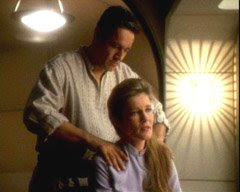 501. ResolutionsFORMULA: Attached + The Galileo Seven ± LifesignsWHY WE LIKE IT: What might've been.WHY WE DON'T: RESET BUTTON!REVIEW: After a number of episodes where he is sidelined, Chakotay gets to do a little something. I do wish they'd think of something more than have him spout Native axioms and legends, but he's here represented as an outdoorsman and a builder of things. The predicament is an unusual one, a Gilligan's Island inside a Gilligan's Island, you might say: Janeway and Chakotay have gotten a disease that prevents them from leaving a planet, so they stay behind and rough it.Janeway's determination prevents her from stopping her efforts to find a cure, while Chakotay is more acceptant of the situation and like the wise man he is, lives for the present. And is he looking to pull off a little Adam and Eve while he's at it? This remains ambiguous, but the situation does bring the two characters closer together and Chakotay will allow whatever happens to happen. If Janeway's goal is to find a cure, his is to devote himself completely to the only other person on the planet. If that leads to something (and given the circumstances, it's probably inevitable), so be it. Unfortunately, the relationship that develops is abandonned by episode's end. When they are eventually rescued (we were of course expecting it), they get right back to business and "commander" and "captain" as if nothing happened. This leads us to think that maybe something DID happen, but while it's fine not to show your hand to the crew, why was it necessary to avoid the issue even behind closed doors for the rest of the series? (The producers, when interviewed for DVD extras, are big on saying they took risks with this series. Well, I say they didn't take ENOUGH risks. Or at least never followed through on the risks they did take.)Meanwhile, back on Voyager, it's like we're back on TOS as nobody trusts a Vulcan in command. At least this time the crew doesn't act criminally. There's no racism, and there's no talk of mutiny. That's refreshing, to be frank. They convince Tuvok to change his mind through good old-fashioned talking. The Vidiians make their last appearance on the series, and for once, they think of contacting Denara Pel, the one friendly Vidiian, for help. Not that it prevents the rest of her people from jumping the ship. Not a bad little battle either.Other notes: This episode takes about four months to resolve itself, which is good justification why we're still in Kazon space. Why Tuvok never changes into a red uniform is never explained however. One thing that bugged me is the plasma storm on the planet. Why not just a hurricane? This seems like SF terminology gone out of control. Plasma is super-heated gas and would probably destroy a planet's ecology a lot more. Nice monkey though.LESSON: What happens on the away mission, stays on the away mission.REWATCHABILITY - Medium-High: Sadly, Voyager is getting good at ignoring its own character continuity (even though it mentions event continuity when possible), so while this episode shows four months' worth of growth on the part of two key characters, it won't make a lick of difference. Still, a well-crafted piece if you know nothing of the show's future.
 504. Flashback


